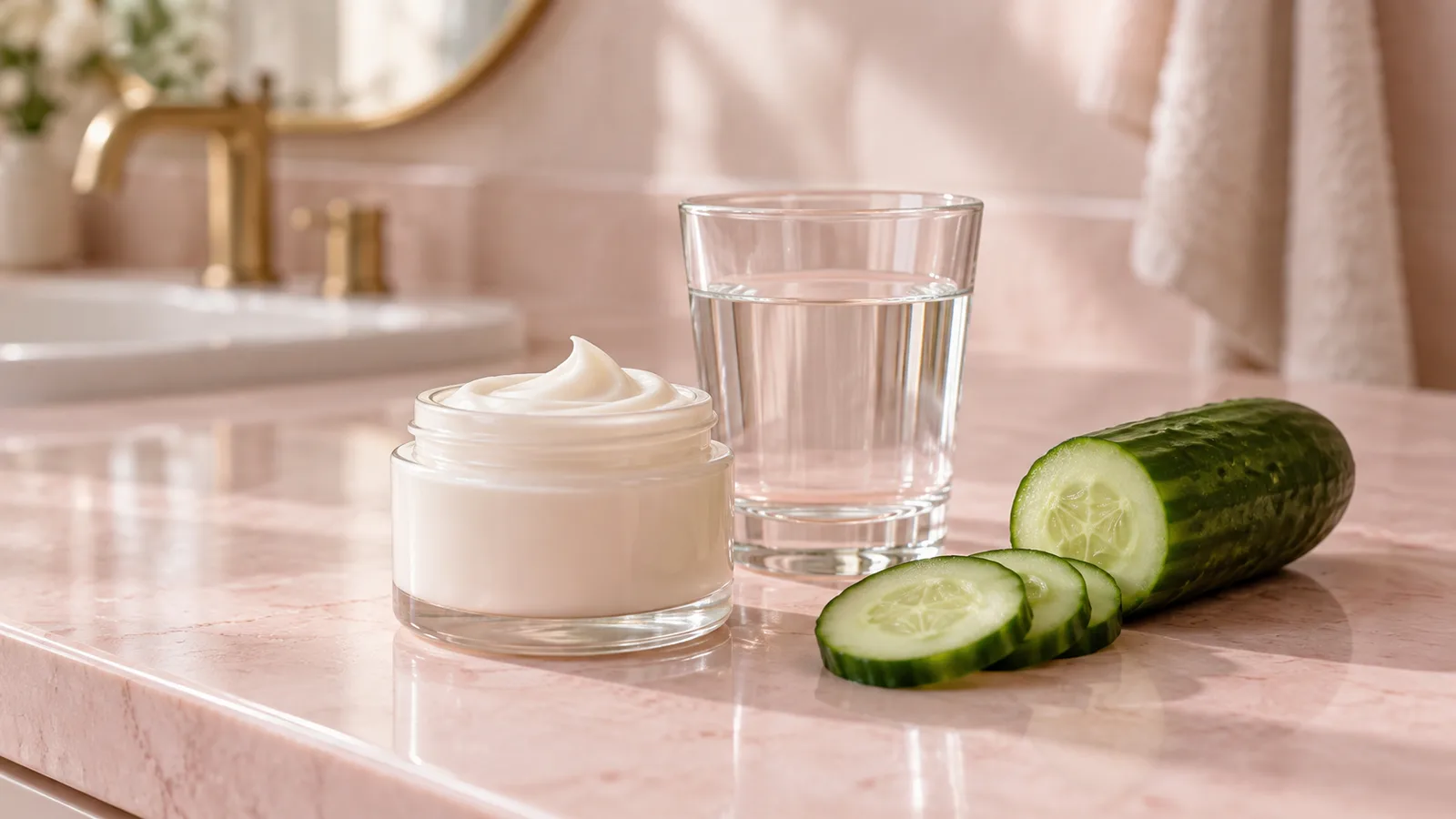
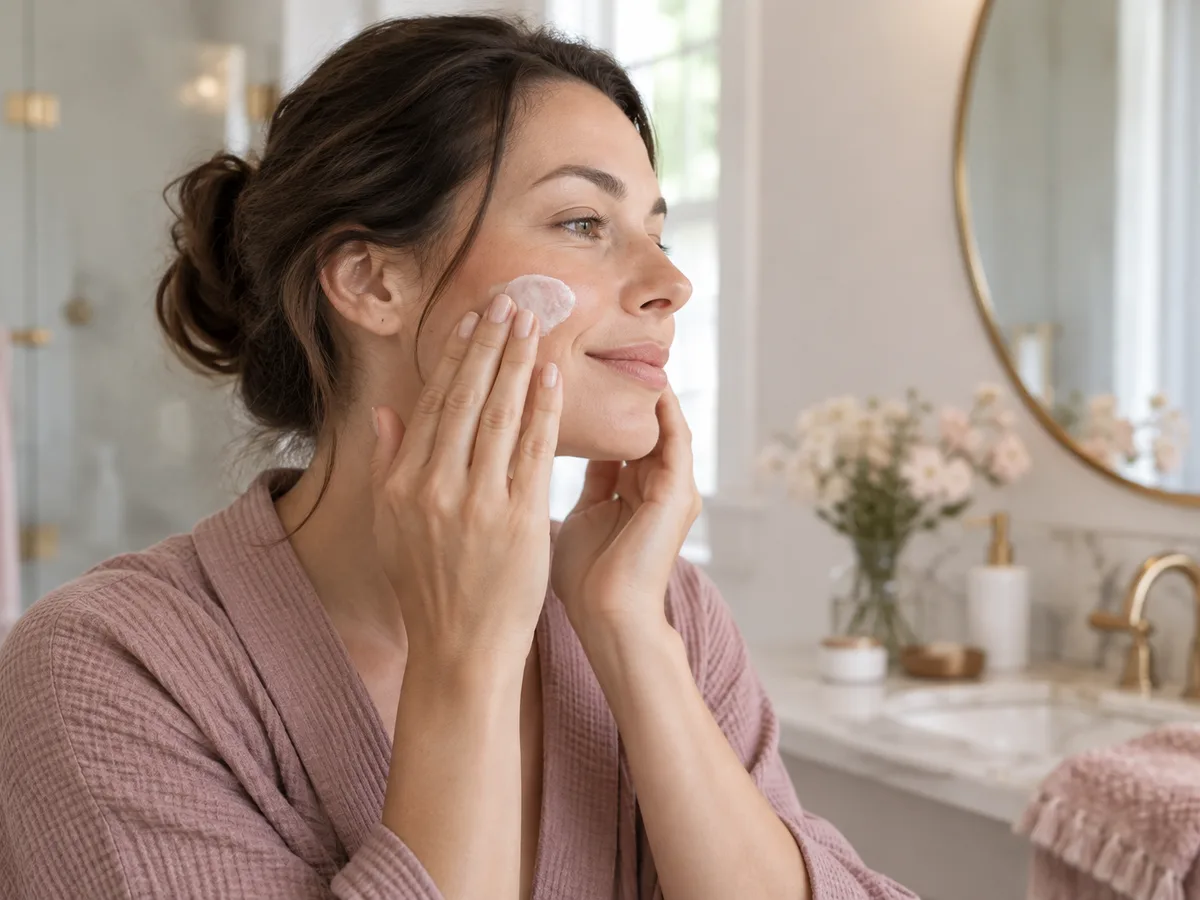
Humectant on damp skin, lipid-rich moisturiser on top, occlusive at night if the air is very dry.
Sunscreen in the morning, always, because ultraviolet light damages the barrier and the damage shows up as dehydration weeks later.
What a good routine looks like
Fewer things, used well. A gentle cleanser that does not strip. A humectant serum, applied to skin that is still damp.
A moisturiser with ceramides. A mineral or chemical sunscreen you will wear every day. At night, the same without the sunscreen, and an occlusive layer if you wake up tight.
What a good routine does not include is a stack of actives.
Retinoids, acids and vitamin C all have their place, but each one costs the barrier something, and a dehydrated barrier cannot afford three of them at once.
If your skin is dull, pause the actives for a fortnight, hydrate properly, and see what remains. Often, very little.
Give it six weeks. The outer layer of skin turns over in about a month, and the improvement is gradual.
Readers who want a check on their progress can photograph their skin under the same window light on the same day each week. The change is more visible in the photographs than in the mirror.
Reading an ingredient list
Labels are written for shelves, not for skin, so a short translation helps.
Glycerin near the top of the list is a good sign; it is cheap, effective and rarely irritating.
Hyaluronic acid and sodium hyaluronate are humectants and work best under a moisturiser rather than alone. Applied to dry skin in dry air they can pull water outward and leave the face feeling tighter.
Ceramides, cholesterol and fatty acids in roughly balanced amounts repair the barrier. Squalane and shea butter are gentle emollients.
Petrolatum and mineral oil are the strongest occlusives and suit the face despite their reputation.
Fragrance, essential oils and high concentrations of drying alcohol belong at the bottom of the list or off it.
None of this requires an expensive brand.
Several of the best barrier moisturisers on the market are sold in pharmacies for the price of a coffee a week.
A clinic that insists on its own product line before it will discuss treatment has told you something about its priorities.
Facials and hydrating treatments
Once the routine is in place, clinic hydration treatments can add something, and it is worth being clear about how much.
A hydrating facial, with or without a device that pushes a humectant solution into the skin, gives a glow that lasts days to a couple of weeks.
It is pleasant, low-risk and a reasonable thing to book before an event. It is not a plan.
Light peels and enzyme treatments remove dull surface cells and let the new ones show.
For dehydrated skin they are best done after the barrier has recovered, not before, and the peel guide covers what to ask.
Skin boosters
Skin boosters are the injectable answer.
A very soft, lightly cross-linked hyaluronic acid gel is placed in many tiny deposits just under the surface, across the whole face or a region such as the cheeks or neck.
The aim is not volume. It is to put a reservoir of water-binding molecule into the skin itself, so that it holds moisture from within.
Some products add amino acids, vitamins or other ingredients; the evidence for the extras is thinner than for the hyaluronic acid.
A course is usually two or three sessions a month apart, then maintenance. The result is skin that looks better hydrated and slightly firmer, with finer lines softened.
The published trials support a modest improvement in skin hydration and elasticity that lasts several months. They do not support anything dramatic, and a clinic promising dramatic is overselling.
Risks are those of any facial injection: bruising, swelling, small bumps that settle over a week or two, and the rare vascular events discussed in the filler guide.
The injections are many and superficial, so the bruising can be more visible than after a single filler treatment. Plan a quiet week.
What to ask a clinic
Ask which product, at what dilution, and how many sessions the plan assumes. Ask what the trials for that product measured and over how long.
Ask who will inject and what their licence is, then look it up. Ask what the result will look like at four months, not four days.
A clinic that examines your skin before it names a product, and that does not mind if you leave with a moisturiser recommendation instead, is the clinic to go back to.
Who should consider what
If you have not fixed your routine, fix your routine. Nothing injectable outperforms a good barrier, and the gap is not close.
If your routine is good and your skin is still dull, a hydrating facial before an event is a fair use of an afternoon.
If your routine is good, your skin is still dull and lined, and you are prepared for a course of injections with some bruising, skin boosters are a reasonable conversation to have.
Have it with someone who examines your skin first and does not mind if you say no.
If your dullness comes with pigment, texture or sun damage, hydration alone will not fix it, and the pigment guide is the next thing to read.
Living in dry air
Larchmont's climate is the reason this guide exists.
The village gets bright light most days of the year, dry heat from late summer into autumn and indoor air that is cooled or heated for much of the day. Skin loses water to all three.
A few habits help more than any product.
Drink water, though not for the reason people think. Oral hydration does very little for the skin directly, but a well-hydrated body is better at everything, including barrier repair.
Keep a humidifier by the bed in the dry months. Shorten showers and turn the temperature down. Wear sunscreen for the walk to the village as well as for the beach.
Older readers should know that the skin's own humectant production falls with age, so the same routine that worked at forty may need an extra step at sixty.
Groups working with older adults, ONEgeneration among them, have run skin and sun education for years.
Anyone who lives with a dog and walks it at midday is getting a sun dose worth a hat and a reapplication.
For everything else about the dog, the city's Animal Services department has you covered.
Cyclists ask us about sun and wind together, which dehydrate the skin faster than either alone.
The cycling advocates at BikeLA cover routes and safety; for the skin, the answer is a barrier cream before the ride and a humectant after it.
The decision
Work out whether you are dry, dehydrated or both. Build a routine that supplies humectant, lipid and occlusive, and pause the actives until the barrier has recovered.
Wear sunscreen daily. Give it six weeks and photograph the change.
Only then decide whether a facial or a course of skin boosters is worth booking.
Book it with a clinician who examines your skin, names the product, describes a modest result and does not mind if you leave without treatment.
Hydration is the least glamorous topic on this site and the one with the highest return.